









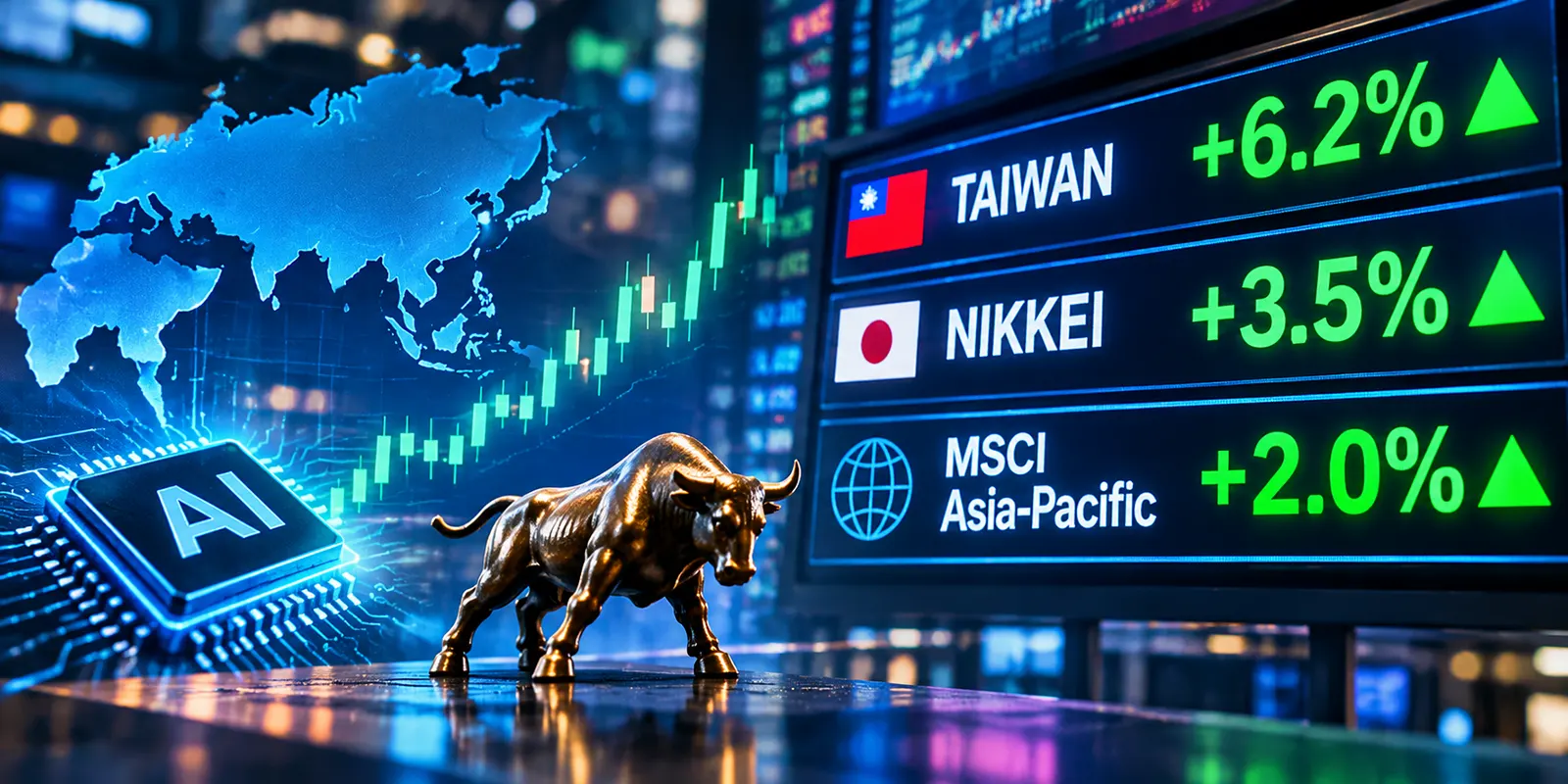
Asian stocks rebound on Monday, November 9, 2026, as investors returned to technology-heavy markets after a sharp selloff linked to concerns about artificial intelligence spending and valuations. Taiwan and Japan led the recovery, while US equity futures also pointed higher in early trading.
The rebound does not erase last week’s losses. According to Reuters, the broad MSCI Asia-Pacific index outside Japan rose about 2% in Monday trading after falling 4.6% the previous week. Figures are intraday snapshots and may change before local markets close.
Asian Stocks Rebound: Taiwan and Japan Lead
Taiwan’s benchmark climbed more than 6% in Reuters’ early report, following its steepest weekly decline in two decades. Japan’s Nikkei advanced around 3.5%, while South Korean shares gained about 1.8%. These moves indicate a sharp change in sentiment, not necessarily a lasting reversal of the recent downtrend.
A separate Associated Press market report also described gains in Taiwan, Tokyo and Seoul, although its snapshots differed slightly because prices changed during the session. Investors should distinguish between intraday quotes and final closing levels.
Why AI-Linked Shares Had Fallen
The prior selloff reflected renewed questions about how quickly large investments in data centers and AI hardware can translate into sustainable profits. Chipmakers and other technology suppliers are particularly exposed to shifts in expectations about AI infrastructure demand.
Political uncertainty added to the pressure after the US midterm elections. Investors assessed whether greater scrutiny of data-center construction and AI regulation could slow planned projects. Such scenarios remain risks rather than confirmed outcomes.
US Futures and the Fed Add Another Layer
S&P 500 futures rose about 0.6% in the Reuters snapshot, suggesting a more constructive opening mood on Wall Street. But futures do not guarantee the direction of the regular trading session.
Stronger-than-expected US employment figures also changed interest-rate expectations. A potentially firmer Federal Reserve stance can raise financing costs and affect valuations of growth companies whose anticipated earnings lie further in the future. For related macroeconomic context, see our analysis of changing Fed rate expectations.
Reading the Asian Stocks Rebound in Context
A large percentage gain can look more decisive than it really is after a steep decline. For example, an index that falls from 100 to 90 loses 10%. If it then rises 10%, it reaches 99, still below its starting point. This arithmetic helps explain why a strong recovery session does not automatically repair earlier losses.
Comparisons also depend on the benchmark. A technology-heavy index can react differently from a broader market index because its sector weights differ. When reviewing the Asian stocks rebound, compare the same index over consistent periods and separate price performance from currency effects. These checks help put dramatic daily headlines into perspective without treating one session as proof of a new trend.
What Investors Should Watch Next
The immediate question is whether buyers can sustain the recovery beyond a single session. Upcoming earnings from AI infrastructure companies, US inflation data and changes in bond yields may influence whether the bounce broadens or fades.
Investors should also monitor market breadth: a rebound concentrated in a few large semiconductor names may be less durable than one supported by multiple sectors. Trading volume and the behavior of major indexes near previous support and resistance levels provide additional context, though none offers certainty.
How to Evaluate the Asian Stocks Rebound
A one-day recovery is easier to interpret when compared with the preceding decline. Investors can examine whether gains extend beyond semiconductor and AI-linked companies, whether trading volume confirms broader participation, and whether indexes hold their advances into the close. These observations help distinguish a market-wide improvement in sentiment from a short-lived bounce concentrated in a few large stocks.
Currency movements and government bond yields may also influence international investors. A strengthening local currency can change returns for overseas shareholders, while rising yields may pressure valuations of technology businesses. None of these signals independently predicts the next session; they are useful pieces of a broader risk assessment.
Bottom Line
Asian stocks rebound after an intense AI-related selloff, with Taiwan and Japan posting notable early gains on November 9. The move signals an improvement in risk appetite, but questions about AI investment returns, interest rates and policy remain unresolved.
Sources
Reuters — Asian stocks bounce as AI and Middle East jitters recede (November 9, 2026)
Associated Press — Asian markets bounce back after AI stock recovery (November 9, 2026)
Financial disclaimer: This article is for information and education only, not investment advice. Market prices and economic expectations change rapidly; consider your own circumstances and consult a qualified professional before making investment decisions.