






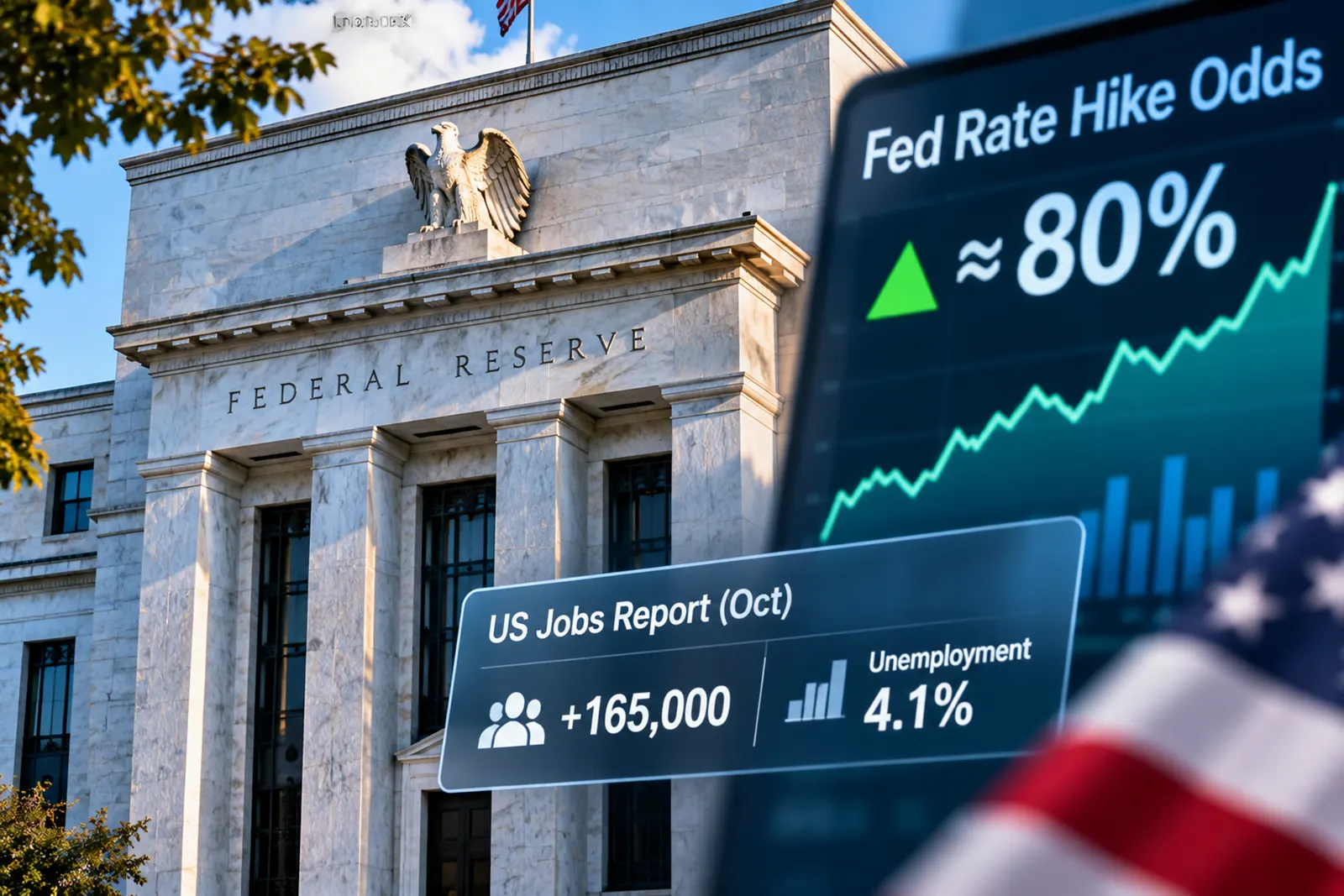
Fed rate hike odds climbed toward 80% following the stronger-than-expected US October employment report released on November 6, 2026. The shift highlights a difficult balance for the Federal Reserve: hiring remains resilient while consumer prices are still rising faster than average wages.
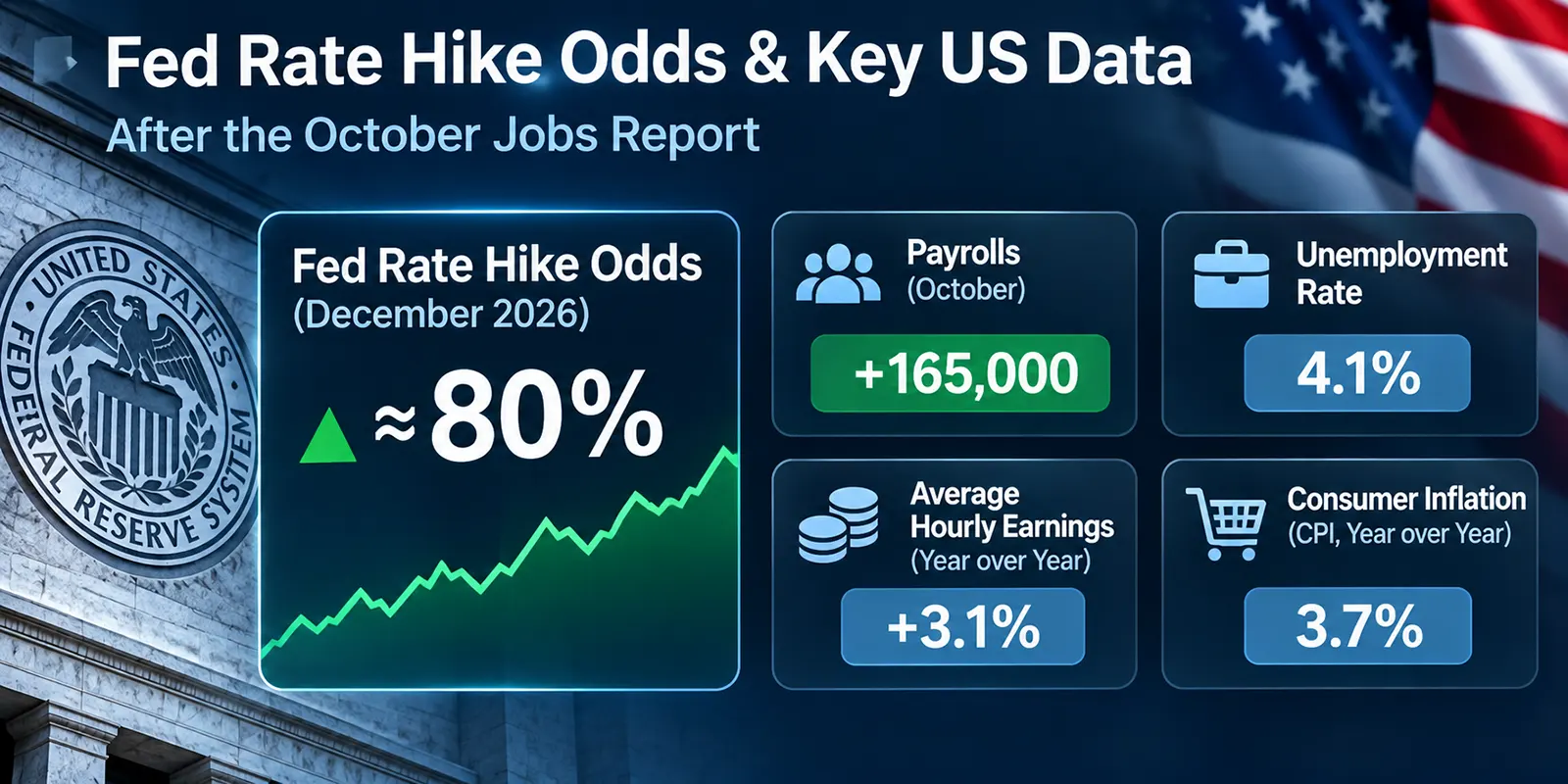
US employers added 165,000 jobs in October, compared with roughly 65,000 forecast in a Reuters survey. Unemployment eased to 4.1%, down from 4.2% in September. These figures supported expectations that the central bank may raise rates at its December 8–9 meeting, although no decision has been made.
Why Fed Rate Hike Odds Rose After the Jobs Report
According to Reuters, traders priced a roughly 80% probability of a quarter-point increase in December after the labor report, versus about 67% a day earlier. Such probabilities are market-implied estimates, not commitments by policymakers, and they can change sharply with new economic releases.
The revised September payroll gain was 60,000, and upward revisions to August and September totaled 84,000. Together with October’s headline gain, these figures suggested more resilience than investors had expected. However, one strong report does not establish a lasting acceleration in hiring.
Inflation Still Outpaces Wage Growth
Average hourly earnings rose 3.1% from a year earlier, while consumer prices increased 3.7% over the comparable annual period, according to Reuters. These measures are not identical to a full calculation of real earnings for every household, but the gap illustrates why purchasing power remains a concern even as employment grows.
Higher interest rates can help curb demand and inflation over time, but they also raise borrowing costs for households and businesses. Policymakers must assess whether inflation pressures are persistent enough to justify additional tightening without unnecessarily weakening the labor market.
What the Federal Reserve Is Watching
The central bank has not precommitted to a December increase. Inflation releases, wage trends, energy prices and changes in labor-force participation could all alter the assessment before the meeting. The latest employment report also showed pockets of labor-market softness, including involuntary part-time work, which caution against relying on the payroll headline alone.
The rate outlook matters for Treasury yields, the US dollar and interest-sensitive equities. Investors can review our earlier analysis of US inflation in September 2026 for background on the price pressures behind the policy debate.
How to Interpret Changing Rate Expectations
Market-implied probabilities are snapshots of investor positioning, not a direct survey of Federal Reserve officials. They can move as traders respond to employment, inflation and central-bank commentary. For that reason, a shift in Fed rate hike odds should be read alongside the underlying data and the timing of the next policy meeting.
Investors also need to distinguish nominal wage growth from purchasing-power changes. An annual pay increase and an annual consumer-price reading summarize different economic measures; their comparison provides context but does not describe every worker’s experience. Similarly, a headline payroll gain can conceal uneven hiring across industries, making the broader labor-market details important.
Market Implications and Risks
A higher expected policy rate generally supports short-term yields and can pressure valuations of companies whose projected earnings lie far in the future. Yet market reactions are not mechanical: stronger employment can also support corporate revenues. The balance between economic growth and financing costs is especially relevant after recent volatility in technology shares.
The key distinction is between what economic data show, what markets currently expect and what the Federal Reserve eventually decides. Fed rate hike odds reflect trading prices at a particular moment, rather than an official forecast. An implied probability near 80% is not an 80% guarantee of a rate increase.
Bottom Line
Strong October hiring pushed Fed rate hike odds higher, but persistent inflation and mixed labor-market signals make the outlook conditional. The next data releases and policymakers’ communications will matter more than any single probability snapshot.
Sources
Reuters — Fed policymakers consider rate hike after strong jobs report (November 6, 2026)
Reuters — Strong October jobs report sends yields higher (November 6, 2026)
US Bureau of Labor Statistics — Employment Situation
Financial disclaimer: This article is for general information and education only and does not constitute investment advice. Economic releases and market expectations can change; assess risks and consult a qualified professional before making financial decisions.